Best Heated Blankets
Comparison · Heated Throws With a Textured Surface

Jacquard, Waffle or Faux Fur: Which Texture Earns Its Price

Almost every heated throw on Amazon is the same flat flannel or sherpa, because flat fabric is the cheapest shape to thread a heating wire through evenly. Three listings go a different way: a jacquard faux rabbit fur with a wave-textured pile, a waffle-knit throw that fakes the bulk of fur without the weight, and a plain faux fur throw priced nearly double the other two while offering half the heat levels. The texture changes something real in each case — it just doesn't always change the thing the price difference implies.

By Ilane Tall · Updated November 26, 2026 · Research-based.

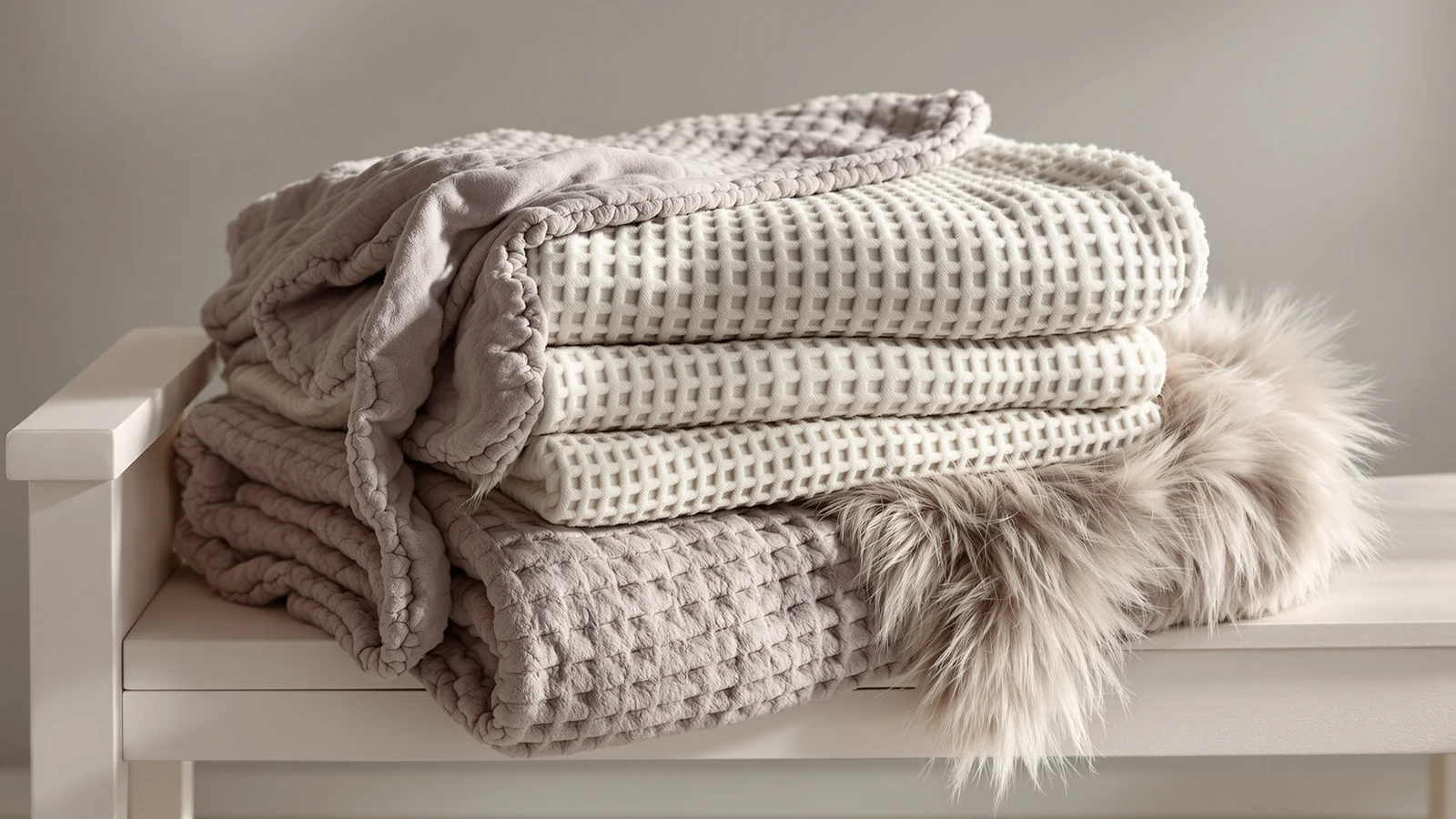
Three heated throws laid side by side showing a wave-textured jacquard faux fur surface, a waffle-knit weave, and a plain faux fur pile
Quick answer

Texture changes feel and bulk — not automatically heat levels or price-per-level

Most heated throws stay flat flannel or sherpa because a flat, even surface is the simplest thing to run a heating wire through without bunching. Three products in our research set break that pattern. The RUVENOX Jacquard Faux Rabbit Fur Throw ($32.12) uses a knit wave pattern across a 350 GSM faux-fur pile, and still carries 12 heat levels and a 1-to-12-hour timer. The Eastsora Waffle Throw ($27.61) gets its texture from a woven grid instead of a pile, which keeps it lighter than fur, and matches the same 12 levels at the lowest price of the three. The HaloRest Faux Fur Throw ($56.98) is the heaviest pile at a combined 700 GSM, but it ships with only 6 heat levels and 4 fixed timer presets instead of a selectable range.

Below: why flat fabric dominates this category, what each textured surface is actually built from, our picks among the three, and whether texture changes how a throw washes and dries.

Disclosure: this article contains affiliate links. If you buy through one, we may earn a commission at no extra cost to you — see our About page for how we research.

The default

Why most heated throws stay flat, and what texture changes

A heating element in an electric throw is a thin insulated wire, run in a repeating grid pattern through the fabric so warmth spreads evenly rather than pooling in hot spots. That grid is easiest to lay flat: on plain flannel or sherpa, the wire sits at a consistent depth across the whole surface, manufacturing is simple, and the finished blanket is thin enough to fold into a drawer. That is the entire reason the category defaults to flat fabric — not a lack of better options, but the fact that flat is cheaper and more predictable to build around a heating circuit.

A textured surface complicates that in two different ways, and the three throws here split neatly along the line. A knit or woven texture, like the Eastsora's waffle grid, changes the surface geometry without adding real bulk — the raised pockets are formed by the weave itself, so the fabric stays close to flannel-thin even though it looks and feels different in the hand. A pile texture, like the RUVENOX jacquard faux rabbit fur or the HaloRest plain faux fur, adds an actual layer of fiber on top of the heating grid. That pile traps air the way any fur or sherpa does, which is insulation the blanket has before you ever plug it in — a real physical difference, not a cosmetic one. It also adds weight, thickness and dry time, which is the trade a flat flannel throw doesn't ask you to make.

Variety in surface finish is not limited to weave and pile, either — the same logic of trading simplicity for a different feel shows up in throws that skip solid colors for prints and patterns instead of plain grey, where the trade is visual rather than tactile. Here, with all three throws anchored to the same 50×60″ single size, the only variables worth comparing are the surface itself, the heat-level count, and what the price actually buys at each tier.
Pile with a pattern

Jacquard faux rabbit fur: the wave pattern and what it does to warmth retention

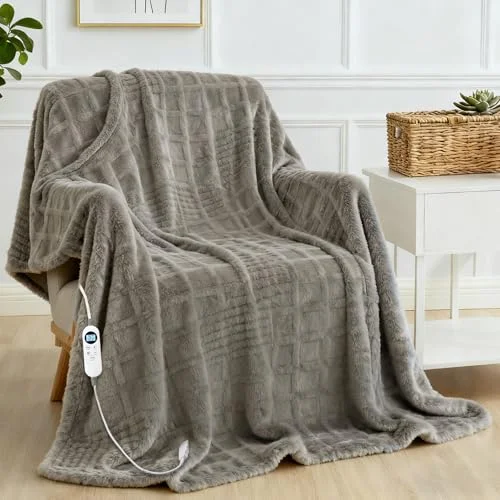
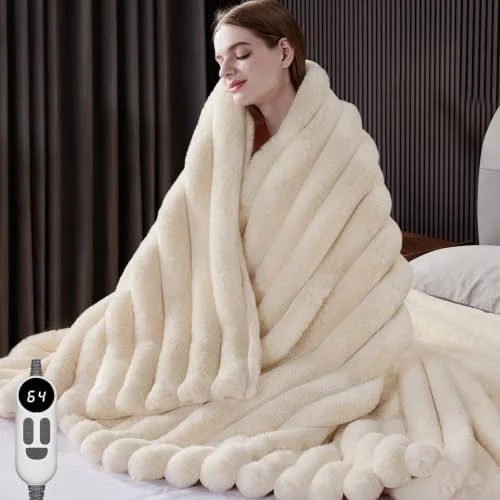
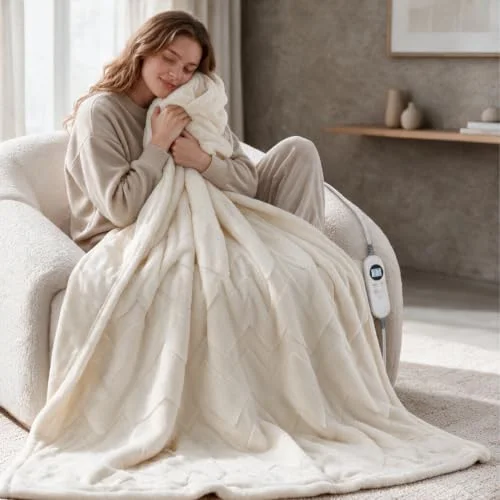
The RUVENOX Heated Blanket Electric Throw builds its texture into the pile itself rather than printing it on top. The face is 350 GSM jacquard faux rabbit fur — jacquard here meaning the wave pattern is knit directly into the fur during manufacture, so the ridges are a structural part of the fabric rather than a surface treatment that can flatten or wear off in the wash. The reverse side is a separate 200 GSM flannel layer, giving the blanket two distinct faces: a textured, higher-loft fur side and a smoother flannel side, for a combined 550 GSM of fabric wrapped around the heating grid.

That extra loft is the warmth-retention argument for a textured pile over flat flannel: a wave-patterned fur surface has more raised structure per square inch than a flat weave, which means more trapped air near the body before the heating element adds anything. RUVENOX pairs that with 12 adjustable heat levels and a 1-to-12-hour timer that includes a preheat step — the blanket starts at its highest setting to warm up quickly, then drops back to whatever level you had selected, so you get the speed of a high setting without having to remember to dial it down yourself. The listing states the blanket is machine washable, in Cream White, sized for a single person at 50×60″, and priced at $32.12.

Against the other two, RUVENOX sits in the middle on price and matches the cheaper waffle throw on both heat levels and timer range. The jacquard texture and the extra fur loft are what the roughly $4.50 premium over the waffle throw buys — not more control, since the control specs are identical.

Weave, not pile

Waffle weave: texture without the bulk of real fur, at the same 12-level count

The Eastsora Heated Blanket Electric Throw takes the opposite route to a textured surface. Instead of adding a pile on top of the heating grid, it's woven in a waffle pattern — raised, grid-like pockets formed by the weave structure itself, the same construction idea as a waffle-knit bath towel or thermal underlayer. Because the texture comes from how the yarn is woven rather than from an added fur layer, the fabric stays closer to flannel's thickness and weight than either faux fur throw here, even though it reads as more three-dimensional than a flat weave. The listing does not publish a fabric weight for this one, so we won't assign it a GSM figure the way we can for the two faux fur throws — what we can say with confidence is that a woven texture, by construction, adds far less bulk than a pile does.

On control, the Eastsora throw matches the RUVENOX jacquard exactly: 12 heat levels and a 1-to-12-hour timer, described on the listing as fast-heating. It carries ETL and FCC certification with overheat protection, comes in Light Gray, is sized the same single 50×60″, and at $27.61 it is the least expensive of the three. Eastsora already has a track record in this category — we've previously compared two other Eastsora throws that both claim 12 heat levels, one ribbed flannel and one faux fur over flannel, so this waffle version is effectively a third surface finish from the same brand at the same control spec.

The practical case for the waffle throw is straightforward: if what you actually want is a flat flannel throw's weight and dry time with a more interesting surface to look at and touch, the waffle weave gets you there without asking you to carry a heavier, slower-drying pile around the house. It gives up the faux-fur insulating loft that the jacquard throw adds on top of the heating element, but it gives up nothing on heat levels or timer range to get there.

The expensive one

Plain faux fur at nearly double the price with half the heat levels: what you're actually paying for

The HaloRest Heated Throw Blanket is a plain faux fur throw — no jacquard pattern, no weave trick, just fur — and it's built from the heaviest fabric of the three: 500 GSM faux fur on the face plus a 200 GSM backing, a combined 700 GSM against the RUVENOX jacquard's 550 GSM. At $56.98 it costs almost exactly $25 more than the jacquard throw and over $29 more than the waffle throw, which on the waffle comparison is close to double. For that premium, HaloRest gives you fewer controls, not more: 6 heat levels instead of 12, and 4 timer presets rather than a selectable 1-to-12-hour range. It does carry the same ETL and FCC certification and overheat protection as the Eastsora throw, with insulated heating wires the listing describes as built to dissipate heat evenly and avoid short circuits.

What the extra money buys is raw fabric weight, not features. At 700 combined GSM, HaloRest is a noticeably heavier, denser faux fur blanket than either of the other two before you factor in the heating element at all — the kind of throw that already feels substantial and warm as plain bedding, with the wiring there to extend that warmth rather than create it from a thin base layer. That's a legitimate thing to pay for if what you want is a heavy, plush blanket first and heating second. It's a bad trade if heat-level granularity or an adjustable overnight timer is what actually decides your comfort, since on both of those counts the $27.61 waffle throw and the $32.12 jacquard throw outperform it for less money.

This is the same pattern we've seen elsewhere in the category: more money doesn't reliably buy more control. We found the inverse version of this trade-off when two cheaper Eydna queen blankets turned out to carry more heat levels than their costlier sibling, and the general question of whether a higher level count buys anything you'd actually feel is one we dug into directly when one queen blanket advertised 20 heat levels against the usual ten or fewer. The HaloRest throw sits on the other side of that same question: here, a lower price bought more levels, and the highest price bought fewer.

Our picks

The picks, by what you actually want from the texture

All three are single 50×60″ throws. Ordered by which job each textured surface does best.

01Best balance

RUVENOX Jacquard Faux Rabbit Fur Throw

Added pile warmth without giving up control or paying the fur premium
50×60″ · 12 heat levels · 1–12 h timer with preheat · 350 GSM jacquard fur / 200 GSM flannel reverse

This is the one that gets the pile's extra loft and the full 12-level, 1-to-12-hour control range at the same time, for $4.50 more than the waffle throw and $24.86 less than the plain faux fur. The preheat step — a fast run at the highest setting before settling back to your chosen level — is the kind of detail a flat flannel throw rarely bothers with. If you want the textured-pile feel without HaloRest's price or its reduced control, this is the one to buy.

RUVENOX jacquard faux rabbit fur heated throw blanket in cream white
$32.12
Single 50×60″Check price →
02Best value

Eastsora Waffle Heated Throw

The texture without the fur weight, and the cheapest of the three
50×60″ · 12 heat levels · 1–12 h timer, fast heating · waffle weave · ETL & FCC, overheat protection

Same 12 heat levels and the same 1-to-12-hour timer as the RUVENOX, at $27.61 — the lowest price in this comparison. You give up the insulating pile a fur surface adds on top of the heating grid, but you get a lighter, flatter blanket that should sit closer to flannel in weight and dry time. If a more interesting surface is the whole goal and you don't need the extra bulk of fur, this is the one to buy first.

Eastsora waffle weave heated throw blanket in light gray
$27.61
Single 50×60″Check price →
03Heaviest pile

HaloRest Faux Fur Throw

For a plush, substantial blanket first and heat control second
50×60″ · 6 heat levels, 4 timer presets · 500 GSM faux fur / 200 GSM backing · ETL & FCC, overheat protection

At $56.98 and 700 combined GSM, this is the heaviest and most expensive throw here, and it reads that way in the hand before you ever plug it in. The trade is real: half the heat levels of the other two, and a fixed set of four timer presets instead of a selectable range. Buy this one specifically for the fabric weight, not for more control — on control it's the weakest of the three despite the price.

HaloRest plain faux fur heated throw blanket, cream white
$56.98
Single 50×60″Check price →
ModelTextureFabric weightHeat levelsTimerPrice
RUVENOX Jacquard FurJacquard wave, faux fur pile350+200 GSM121–12 h, preheat$32.12Price
Eastsora WaffleWaffle weave, no pileNot published121–12 h$27.61Price
HaloRest Faux FurPlain faux fur pile500+200 GSM64 presets$56.98Price
Upkeep

Does a textured throw wash and dry differently than flannel?

Yes, and the difference tracks the same split as the warmth question: it's about pile versus weave, not about texture in general. The RUVENOX listing states the jacquard throw is machine washable outright. Neither the Eastsora nor the HaloRest listing makes that claim explicitly in its own words, though a detachable controller — standard across this category once the cord unplugs from the heating element — is the industry default that makes washing possible at all; confirm it on the specific listing before you rely on it rather than assuming it from this comparison.

Drying time is where the construction difference shows up most. A waffle weave, because it adds texture without adding a real pile layer, should behave close to a flat flannel throw in the wash: it holds less water, and a standard home dryer on low gets through it in roughly the time a flannel throw takes. A faux fur pile is a different story. Both the RUVENOX jacquard and the HaloRest plain faux fur have genuine fiber pile on top of the heating grid — more so on the HaloRest, at 500 GSM face weight against RUVENOX's 350 — and pile traps water the same way it traps air. Expect a noticeably longer dry cycle on either faux fur throw than on a flannel or waffle-weave throw of the same size, and expect the heaviest pile to take the longest.

The rule that doesn't change by texture: never machine-wash or submerge the controller itself, whatever the fabric on top of the heating grid looks like. That's a constant across every throw in this category, textured or not.

How we picked

Three surfaces, chosen for contrast

Rather than survey every heated throw with some kind of texture, we picked three that illustrate the real decision inside this corner of the category: a jacquard pile, a woven waffle surface with no added pile, and a plain faux fur pile at a much higher price. Each had to publish a complete specification — finished size, heat-level count, timer behaviour, fabric construction and a named safety certification — before we would compare it. A throw whose listing only claimed "soft" or "cozy" with no construction detail went out of the running, consistent with how we approach every comparison on this site.

How we compared

Research, not a lab

We're honest about this: we don't physically test these blankets and we don't run a testing lab. We compare published specifications, stated fabric weights and safety certifications, live pricing, and the physical construction logic of weave versus pile, and we anchor every claim in that published data plus general, verifiable facts about how each fabric type behaves. Amazon no longer exposes verified star ratings or review counts through its product API for any of these three listings, so this guide contains no rating badges, no scores, and no paraphrased review sentiment — we simply don't have that data for these products.

FAQ

Common questions

Does a jacquard or waffle texture actually trap more heat than flat flannel?

It depends on which kind of texture. A pile texture, like the RUVENOX jacquard faux rabbit fur, adds a genuine layer of fiber on top of the heating grid, and that fiber traps air the way any fur or sherpa does — a real insulating effect before the element is even on. A woven texture, like the Eastsora waffle weave, changes the surface geometry without adding real bulk, so it shouldn't trap meaningfully more air than a flat flannel throw of similar thinness; the appeal there is the feel and look, not extra loft.

Why does the HaloRest faux fur throw have fewer heat levels than the cheaper options?

We don't have the manufacturer's reasoning, only the published specs: HaloRest ships with 6 heat levels and 4 timer presets, against 12 levels and a 1-to-12-hour selectable timer on both the $27.61 Eastsora waffle throw and the $32.12 RUVENOX jacquard throw. What HaloRest does offer instead is more raw fabric weight — 700 combined GSM against RUVENOX's 550 — so the higher price there appears to buy pile thickness rather than finer heat control.

Do textured heated throws take longer to dry than a flat flannel throw?

A woven texture without added pile, like the waffle weave, should dry close to a flannel throw's time, since it isn't holding meaningfully more water. A faux fur pile, like either the RUVENOX jacquard or the HaloRest plain faux fur, holds more water in its fiber and will take noticeably longer in the dryer — expect the heavier 500 GSM HaloRest pile to take longer than the 350 GSM RUVENOX pile. On all three, unplug and remove the controller before washing.

Is a waffle weave warmer than a plain faux fur throw?

We don't have thermal testing data for either, so we won't claim one runs warmer than the other in use. What we can say from the published construction is that the faux fur throw adds an insulating pile layer the waffle weave doesn't have, which should mean more trapped warmth from the fabric itself before the heating element engages. The waffle throw matches the fur throw's heat-level range on paper and costs less, but it is doing that without the same fiber loft.

Keep reading

Related reading