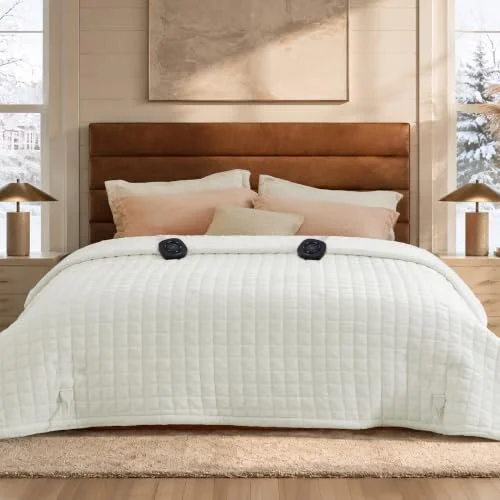
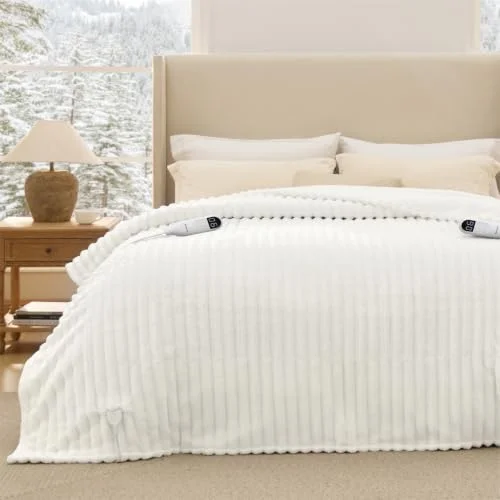
Here is where the three listings actually separate. The striped flannel publishes the most complete spec sheet of the group: six heat settings and six time settings, with an 8-hour timer auto shut-off. That gives you six fixed points to choose a warmth level, paired with six preset run-time windows that cap out at eight hours — enough for a full night's sleep, though not adjustable beyond that ceiling. The quilted ivory doubles the heat-setting count to ten, and instead of fixed timer presets it offers a selectable auto-off anywhere from one to ten hours, so the same blanket that gives a finer gradient of warmth also gives you more control over exactly how long it stays on. Bedsure markets this model's fast-heating behavior alongside the preheat function, which is consistent with the extra settings being a genuine control upgrade rather than a marketing number.
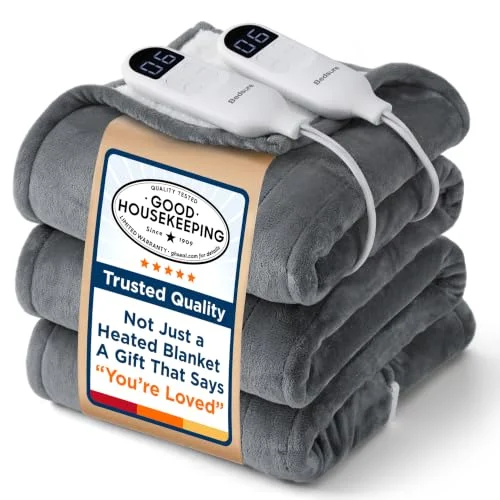
The plain grey sits at six heat settings too, the same count as the striped flannel, which is the detail that makes the pricing gap between these two listings hard to justify on control alone — they offer the same number of heat levels, yet the striped flannel currently lists about thirteen dollars higher. What the grey listing does not publish, and what we are not going to guess at, is a specific auto-off window; the listing simply doesn't break that figure out the way the other two do. That gap in published detail is itself worth noting, because it means buyers comparing all three side by side are working with uneven information — two listings that spell out exact hour ranges, and one that doesn't, independent of what any of them actually cost.
If the number of heat settings is the thing you're actually optimizing for when you shop queen blankets, it's worth knowing this isn't unique to Bedsure's catalog — plenty of brands price their highest heat-level count below a model with fewer settings, for reasons that have nothing to do with control. We've seen the identical pattern play out with another brand's three queen blankets, where the two cheapest carried more heat levels than the priciest, and separately asked whether a blanket advertising twenty heat levels actually buys more usable control than one with half that count. The short version in both cases, and in this one: heat-setting count tracks construction and features more than it tracks price.